
Emergency egress is not just a safety topic. In a warehouse, it is a layout rule. It affects where you place pallet racking, pick modules, mezzanines, staging lanes, and pedestrian walk paths.
When exit routes are left until the end, problems show up during inspections or after day to day habits block the path.
This guide explains how to plan egress early and how to keep it clear when the building is busy. It is written for warehouse operators and facility managers in and around Cranbury, New Jersey.
This is not legal advice. Always confirm requirements with your authority having jurisdiction and qualified professionals. This is for information and education only.
What “Means of Egress” Means in a Warehouse
A means of egress, often called an exit route, is the continuous path people use to get from work areas to safety outside. Many standards describe three parts:
- Exit access: the portion of the route that leads toward an exit.
- Exit: the protected component that leads people out.
- Exit discharge: the path that leads to a public way or a safe open area outside.
In a warehouse, exit access is where most failures happen. The same aisles used for travel are also used for staging, picking, and replenishment. That is why layout planning and daily operations must work together.
Which Rules Apply in Cranbury and Why Local Context Matters
Warehouse egress planning sits in a mix of workplace rules and building and fire codes.
- Workplace rules (OSHA) address exit routes and how they must function and be maintained.
- Building and fire codes address items like travel distance, exit count, occupant load, and construction features that affect exits.
In New Jersey, the Uniform Construction Code is the statewide framework administered through the New Jersey Department of Community Affairs. New Jersey’s current building subcode is based on the 2021 International Building Code, New Jersey edition.
Locally, Cranbury’s Construction Code Enforcement office and Fire Safety Bureau are part of the authority having jurisdiction for many life safety topics that intersect with warehouse projects.
Practical takeaway: coordinate earlier than you think. It is easier to fix an egress issue in the drawing phase than after racking and processes are installed.
Core OSHA Exit Route Requirements That Shape Warehouse Layouts
This section summarizes the concepts that most often drive warehouse layout decisions. For the exact text, always check current OSHA standards and related official guidance.
How many exit routes you need
OSHA generally requires at least two exit routes, with limited exceptions. Larger or more complex buildings may need more.
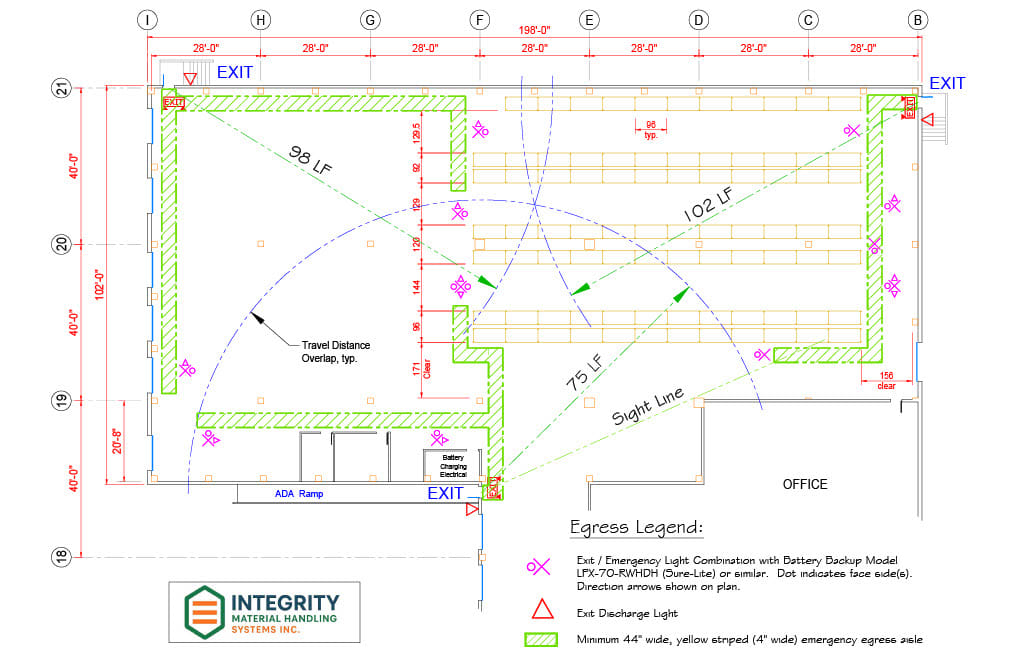
Layout impact: map exits and the exit access paths before finalizing racking density and cross aisle placement.
Exit doors must function as true emergency exits
Exit route doors must be able to open from the inside without keys, tools, or special knowledge. Exit doors and routes must not be blocked by stored product, equipment, or staging.
Layout impact: do not rely on an operational overhead door as your only people egress option. Make personnel egress doors obvious and keep them accessible during normal operations.
Minimum width, height, and capacity
Under OSHA’s exit route standard (29 CFR 1910.36), the ceiling height along an exit route must be at least 7 ft 6 in, and any exit access path must be at least 28 inches wide at all points. These are minimums and may need to be wider based on occupant load and applicable building/fire code. These OSHA minimums apply to designated exit routes and exit access paths, not to every warehouse or rack aisle.
OSHA also requires exit route capacity to be adequate for the occupant load served, which can mean you need more than the minimum width depending on how many people the route serves.
Layout impact: the narrowest point becomes the choke point. In many warehouses, the pinch point is operational, not structural.
Maintenance rules that connect directly to daily behavior
Exit routes must be free and unobstructed. Materials and equipment may not be placed in an exit route, even temporarily. Exit routes must be adequately lighted and marked, with signage that helps people find the exit.
Operational impact: if a cross aisle is part of exit access, treat it like a safety system, not a convenient parking lane.
Travel Distance: Verify the Number for Your Building
Travel distance is typically a building and fire code issue. In IBC based tables, exit access travel distance can vary by occupancy group and sprinkler status. In many IBC editions, the common reference values include:
- S 1 Storage: 200 feet without sprinklers and 250 feet with sprinklers
- S 2 Storage: 300 feet without sprinklers and 400 feet with sprinklers
Other jurisdictions and code editions can differ, and state or local amendments can change the numbers.
What this means for Cranbury:
- Do not use example distances as design targets without confirming the adopted code edition for your project, your occupancy classification (for example S 1 vs S 2), sprinkler status, and any New Jersey or local amendments.
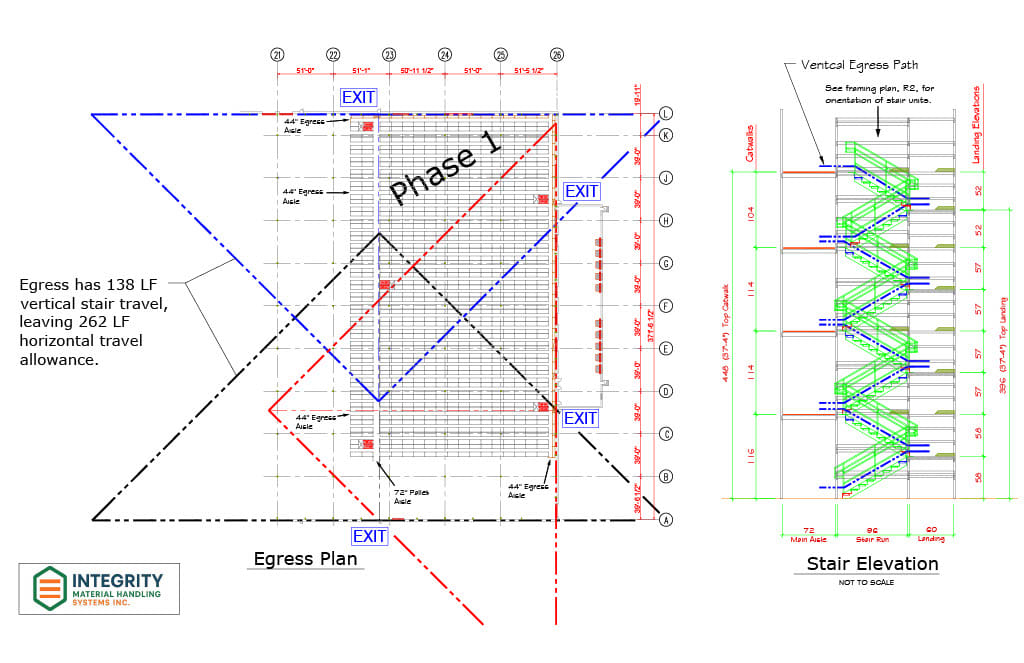
- Mezzanines and long runs of shelving can make travel distance harder to meet and can affect required exit count and stair locations.
A Practical Workflow for Planning and Maintaining Egress
Plan egress early
Create an egress overlay on your layout drawing. Label exit access paths. Mark travel direction to each exit. Recheck it whenever you change racking or processes.
Design staging so it never overlaps egress
Most warehouse egress failures come from a common pattern: a pallet needs a short term place to sit, and the nearest open space is the cross aisle that is also exit access.
Fix this with a real staging plan:
- Create staging zones outside the egress path.
- Make them obvious with floor markings if needed.
- Train to them and enforce them.
Build simple operating controls
Use a short weekly walk through checklist. Include exit routes and exit doors. If a route is blocked, clear it right away. Then record why it happened. Patterns show you where the layout is fighting the operation.
Treat layout changes as egress events
Any time you add racking, change aisle widths, add a mezzanine, or change dock processes, revisit egress. Small changes can create new pinch points.
If you are planning a new rack layout or expanding an existing system in Cranbury or Central New Jersey, we can help you draft or review your plan early, create an egress overlay, and reduce pinch points before installation. Send us a message or call 201 848 0054.
A Quick Checklist for Warehouse Egress Planning
- Confirm that exit routes and exit doors are easy to spot from normal work areas.
- Confirm that exit access paths are free of stored pallets, carts, trash, and parked equipment.
- Confirm that exit route doors open from the inside without keys, tools, or special knowledge.
- Confirm that personnel doors are not blocked by dock gear, machines, or staging.
- Confirm that exit signs are visible and not hidden behind racking or tall inventory.
- Confirm that lighting is adequate along the exit route.
- Confirm that the narrowest point on the exit access path still supports the expected occupant load served by that route.
- Confirm that any mezzanine or elevated work area has a clear route to exits and that workers know the path.
Frequently Asked Questions
Q: Can we stage pallets in an exit access aisle if it is only for a few minutes?
A: Exit routes must be kept unobstructed. If staging blocks or narrows an exit access path, it creates an egress problem. The safer plan is a staging zone outside the egress path.
Q: How many exits do we need?
A: OSHA generally expects at least two exit routes, with limited exceptions. Larger or more complex buildings may need more.
Q: Who do we coordinate with for a Cranbury project?
A: Start with your authority having jurisdiction. In Cranbury, that typically involves Construction Code Enforcement and the Fire Safety Bureau. Coordinate early, before purchasing racking or starting installation.
Q: What should we do first if our current layout is already tight?
A: Start with an egress walk through. Identify the narrowest points, the most often blocked segments, and the places where exit signs are hard to see. Fix staging and pedestrian flow first, then evaluate layout changes.
Related Integrity Resources to Link from This Post
Do You Need a Warehouse Rack Safety Assessment? 5 Signs It is Time for an Inspection
How to Maximize Warehouse Space Without Moving: The Benefits of Mezzanine Storage Systems
What to Know Before Buying Used Pallet Racking: Cost, Condition, and Compliance
How to Determine the Appropriate Rack System for Your Storage Needs
Choosing the Right Rack Type for Your Needs
Warehouse Safety Training Program and Checklist