Warehouse Pallet Rack Design New Jersey: Installation & Planning a High-Capacity Storage System
New Jersey warehouses compete for every cubic foot. With lease rates along the Turnpike corridor climbing and labor markets tight, pallet rack design is one of the few variables that facility operators can directly control to increase usable storage density. This guide covers what goes into planning, engineering, and installing a pallet racking system in New Jersey, from code requirements and slab capacity to rack type selection and professional installation, and explains how Integrity Material Handling Systems Inc. supports projects from first layout sketch through final anchor bolt.
Key Takeaways
Integrity Material Handling Systems Inc. ("Integrity") designs, engineers, and installs pallet racking and rack-supported mezzanine systems for warehouses across New Jersey, with particular depth in Middlesex County, Edison, Cranbury, Carteret, and the broader Turnpike logistics corridor. Integrity is not simply a pallet rack vendor; the company is a turnkey warehouse storage and material handling systems provider that handles CAD layout, engineering, permits, seismic calculations, equipment sourcing, professional installation, and ongoing rack safety assessments from one point of contact.
- Pallet racking design in New Jersey must comply with state and local building codes, fire codes, and seismic requirements. Any warehouse racking system exceeding 5 feet 9 inches in height requires a formal construction permit, and pallet racks 8 feet and taller are classified as permanent structures under the New Jersey Uniform Construction Code.
- Well-engineered pallet racking and rack-supported mezzanines can increase storage density inside an existing footprint when configured around verified load capacity, building conditions, and applicable codes.
- Integrity supplies both new and used pallet racking, along with pallet flow, drive-in, cantilever racking, shelving, carton flow, and related material handling equipment to create storage solutions fitted to each facility's inventory and operational profile.
- Selective pallet racking provides direct access to every pallet position, making it the most common configuration for mixed-SKU operations, while drive-in racking can increase storage density by 75 percent for bulk storage of similar products.
Ready to discuss a pallet racking or mezzanine project in New Jersey? Call Integrity at (201) 848-0054 or contact Integrity online to get started.
Why Warehouse Pallet Rack Design Matters in New Jersey's Distribution Corridor
Warehouse space along the New Jersey Turnpike, particularly around Exit 8A, Edison, Cranbury, Carteret, Newark, and Elizabeth, carries some of the highest lease rates on the East Coast. New Jersey hosts over 800 million square feet of warehouse and industrial space, and competition for that space puts a premium on every pallet position a building can yield. Losing usable square footage to oversized aisles, underused clear height, or poorly matched rack types translates directly into higher cost per pallet stored.
The mix of operations in this corridor is broad. E-commerce fulfillment centers near Carteret and Edison need high SKU counts with fast picking. Port-driven distribution centers around Newark and Elizabeth handle heavy pallets flowing through Port Newark-Elizabeth Marine Terminal. Regional 3PLs in Middlesex County store large quantities of goods for multiple customers, often requiring high density storage configurations like pallet flow and drive-in systems alongside selective racking for mixed inventory. Many New Jersey warehouses deal with high rack densities requiring efficient layout planning that accounts for forklift traffic, fire code, and throughput.
Integrity Material Handling Systems Inc. operates in New Jersey and Texas and manages projects nationwide, but the company's East Coast roots give it direct experience with the building stock, permitting requirements, operational demands, and expertise in racking in New Jersey common across central and northern NJ industrial markets. Warehouse design in these facilities must maximize storage capacity and operational efficiency within the constraints of each building's age, clear height, slab condition, and local code environment.
If you are planning a new facility, an expansion, or a reconfiguration in New Jersey, call (201) 848-0054 to speak with Integrity's design and engineering team about your racking needs.
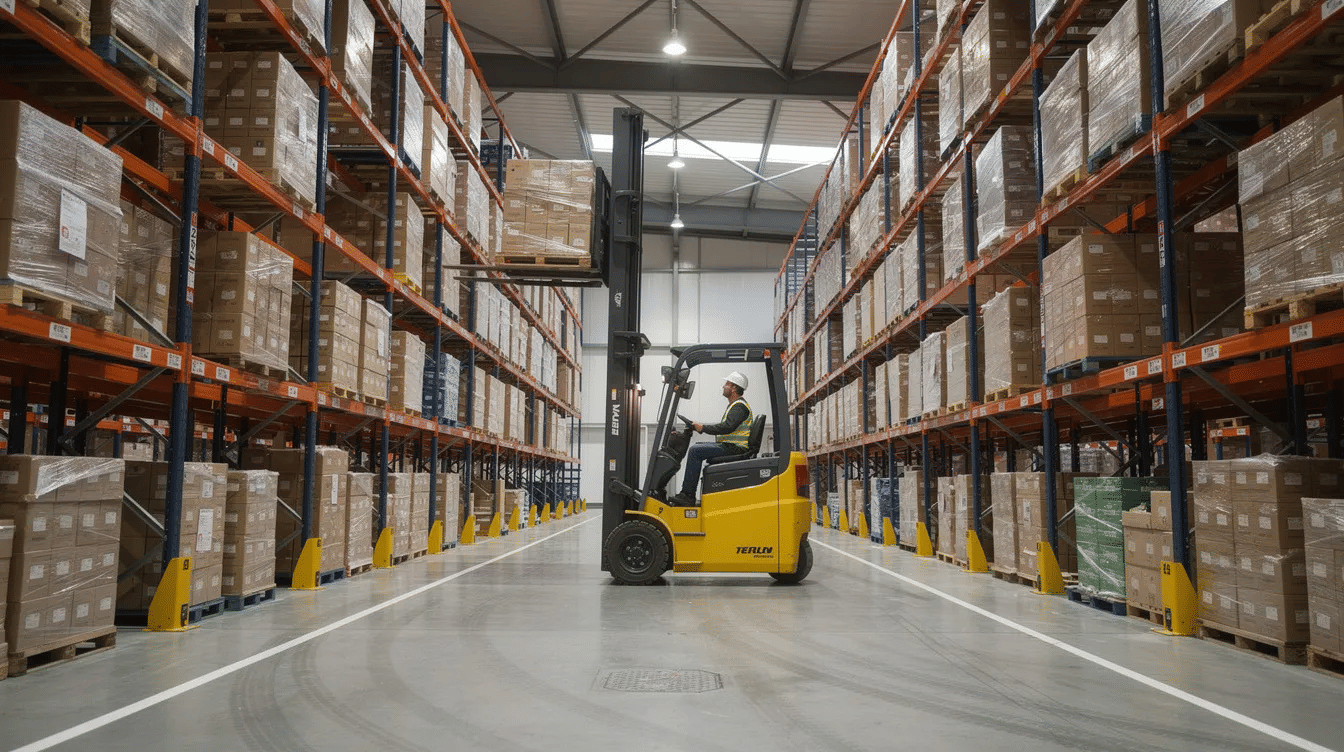
Integrity's Turnkey Approach to Pallet Racking & Material Handling Projects
Integrity manages the full lifecycle of a pallet racking project, from the first conversation about storage goals through installation, safety assessment, and future reconfiguration. This scope includes:
- Warehouse layout and CAD design
- Pallet racking and rack-supported mezzanine design
- Material handling equipment evaluation and selection
- Seismic calculations and permit application support
- Professional equipment installation
- Disassembly, relocation, and rack system reconfiguration
- Rack safety assessments and damage evaluation
- Project management across trades and timelines
Integrity coordinates with fire protection, electrical, lighting, and alarm contractors where needed, so the customer has one point of contact overseeing the storage system implementation. The company also integrates pallet racking with shelving and carton flow systems, conveyors, archive storage, and custom steel fabrication for facilities with unusual column grids, non-standard clear heights, or legacy structures that require creative layout solutions. Free warehouse design consultations help optimize layout before any purchase commitment is made.
Request a custom quote online for a New Jersey pallet racking or mezzanine project.
Step-by-Step: How Integrity Designs a High-Capacity Pallet Rack System
Each NJ or East Coast facility is engineered individually. A warehouse in a 1980s Raritan Center building with 22-foot clear height and a 4-inch slab presents different design constraints than a 2020 tilt-up in Cranbury with 36-foot ceilings and 6-inch reinforced concrete. Integrity's design process accounts for those differences.
The typical sequence:
- Data gathering. SKU mix, pallet dimensions, pallet weights, load capacity requirements, throughput targets, and order profiles.
- Site visit and field measurements. Clear height, column grid, dock door locations, obstructions (ductwork, sprinklers, electrical), floor slab condition, and available space.
- Preliminary layout and pallet count. CAD-based layouts showing rack placement, aisle widths, pick module or mezzanine levels, and projected pallet positions.
- Engineering review. Seismic calculations, slab loading analysis, and capacity verification as required by the project and jurisdiction. Load capacity must be verified and documented based on precision rather than averages.
- Budget and phasing plan. New versus used equipment options, component choices based on availability and supply, lead times, phased installation timelines, and cost breakdown.
- Stamped drawings and installation schedule. PE-stamped engineering documents where required by code, followed by coordinated installation.
Integrity's layouts account for forklift type, aisle width, clear height, dock positions, egress paths, and flue spaces. Aisles should meet both local building code requirements and optimize material handling equipment operation; too wide wastes floor space, too narrow restricts equipment and creates safety risk. Design recommendations may differ across markets like Middlesex County, the Meadowlands, and South Jersey due to variations in building age, clear heights, and floor conditions.
Facility managers unsure where to start can call (201) 848-0054 to review pallet rack designs and layout options with Integrity.
Key Pallet Racking Types for New Jersey Warehouses
Integrity provides a full range of racking systems and frequently combines several types within one facility to balance density, selectivity, and cost. The choice depends on product rotation, pallet weight, order profiles, and the material handling equipment already on site or planned.
| Rack Type | Access / Selectivity | Density | Best For |
|---|---|---|---|
| Selective pallet racking | Direct access to every pallet position | Lower | Mixed SKUs, high-pick operations |
| Double-deep | Moderate; requires reach trucks | Higher | Large quantities of fewer SKUs |
| Drive-in / drive-through | Low; LIFO (drive-in) or FIFO (drive-through) | Very high | Bulk storage of similar products |
| Pallet flow (FIFO) | Moderate; gravity-fed lanes | High | High-throughput, perishable, date-sensitive |
| Push-back (LIFO) | Moderate; carts or rollers | High | Moderate throughput, cold storage |
| Cantilever racking | Direct access per arm level | Variable | Long materials: lumber, pipe, steel, tubing |
Selective pallet racking allows direct access to every pallet, making it the default for facilities with many SKUs and frequent picks. Drive-in pallet racking maximizes storage density for similar products by allowing forklift access into deep lanes; drive-in racking can increase storage density by 75 percent compared to selective layouts. Pallet flow racks use gravity for first-in, first-out storage and support FIFO inventory management in food, beverage, and pharmaceutical operations. Double deep racking reduces aisle space for large quantities of SKUs, though it requires specialized reach trucks. Dynamic racking systems improve storage density using gravity or rails and are often combined with selective bays for slower-moving inventory.
Integrity supplies both roll-formed and structural pallet rack, including pallet racking in new configurations, depending on impact risk, load requirements, and budget. Structural uprights handle heavier loads and resist forklift impacts better; roll-formed is lighter and less expensive per upright but has lower capacity.
Comparing pallet racking solutions for a New Jersey facility? Contact Integrity online for system recommendations tailored to your operation.
Designing for Load Capacity, Safety, and Code Considerations
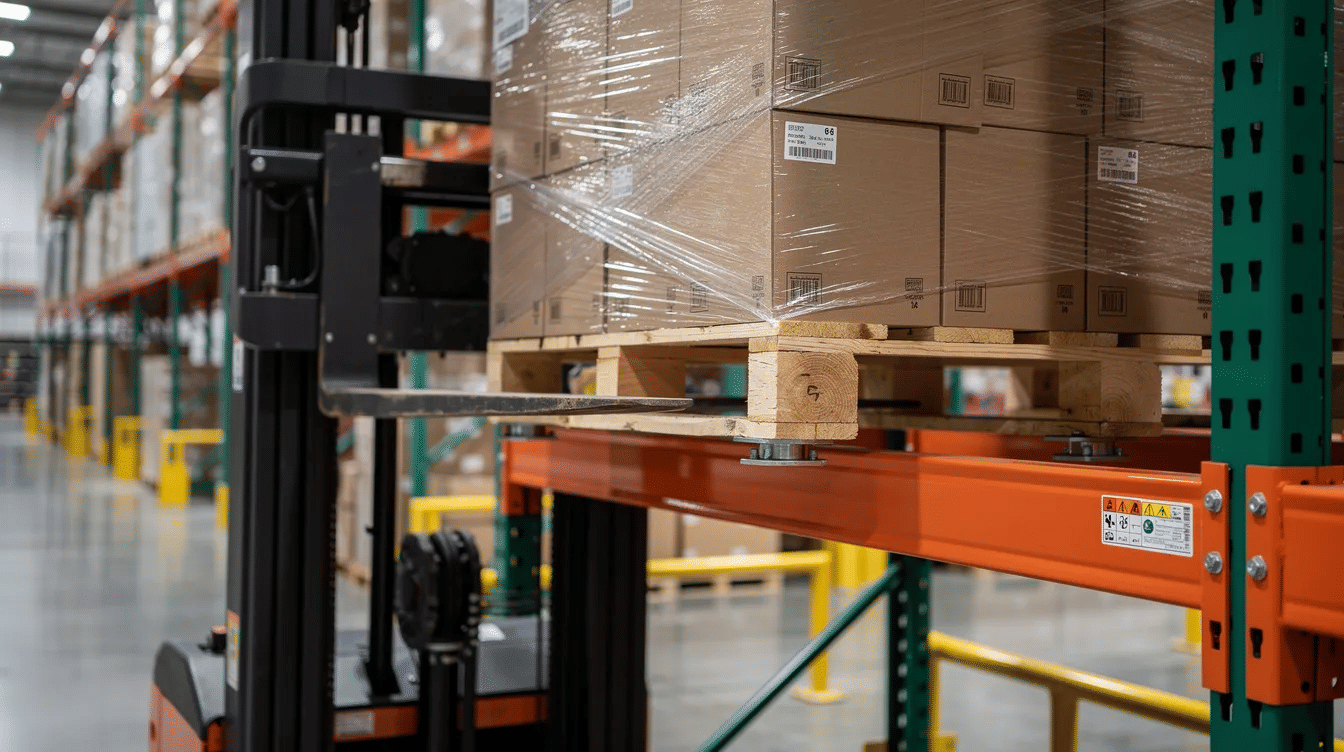
Pallet rack is an engineered structure. Load capacity, configuration, and local requirements must be coordinated with qualified professionals. Designing warehouse pallet racks in New Jersey requires adherence to state and local building codes, and the consequences of skipping this step range from failed inspections to structural collapse.
Load capacity. Pallet racks can hold between 2,000 and 6,000 pounds per pair of beams, depending on beam length, gauge, and upright capacity. Specifying the correct beam capacity, upright capacity, and maximum bay load depends on actual pallet weight, number of levels, and beam spacing. The ANSI MH16.1-2023 standard governs structural design for industrial steel storage racks and requires load capacity plaques posted on every rack system. The Rack Manufacturers Institute provides guidelines for these load capacity plaques. AR Racking meets MHI and RMI standards for quality, and manufacturers that comply with these standards produce components with documented and tested ratings.
Permits and engineering. Under New Jersey's Uniform Construction Code, any warehouse racking system exceeding 5 feet 9 inches in height requires a formal construction permit. Pallet racks 8 feet and taller are classified as permanent structures under the NJ UCC. Municipalities in New Jersey require formal storage rack permits based on height and configuration, and height thresholds trigger specific permit requirements. Rack designs must be reviewed and sealed by a New Jersey-licensed Professional Engineer. New Jersey mandates that seismic calculations for racks 8 feet or taller be carried out by a licensed Professional Engineer.
Fire code. If storage height exceeds 12 feet, a High-Piled Storage Permit is necessary under NFPA 13. New Jersey enforces vertical clearance rules requiring at least an 18-inch gap between stored items and fire sprinkler heads. Racking layout must maintain safe emergency access routes and not impede emergency lighting visibility. Compliance with all applicable building and fire codes is critical for warehouse operations.
Slab and anchoring. Concrete slab capacity must be verified to ensure it can support the weight of pallet racks and their loads. Storage racks must be anchored properly to prevent tipping due to load shifts or impacts. Pallet racks must be bolted to the floor for safety. In older buildings around Newark, Elizabeth, and the Raritan Center area, slabs may be thinner, under-reinforced, or degraded; Integrity can coordinate slab evaluations and the engineering calculations needed to determine whether footings or reinforcement are required.
OSHA. Pallet racking systems must adhere to OSHA regulations and safety requirements. Forklift aisles must be cleared and marked according to OSHA standards for safe operation.
Changing beam elevations in an existing system can alter the maximum unsupported vertical span of uprights, reducing load capacity. Any such change may trigger the need for new engineering review, especially in regions with seismic requirements. Integrity helps customers navigate permitting and works with licensed engineers as required by each jurisdiction.
Rack-Supported Mezzanines, Pick Modules, and Vertical Expansion
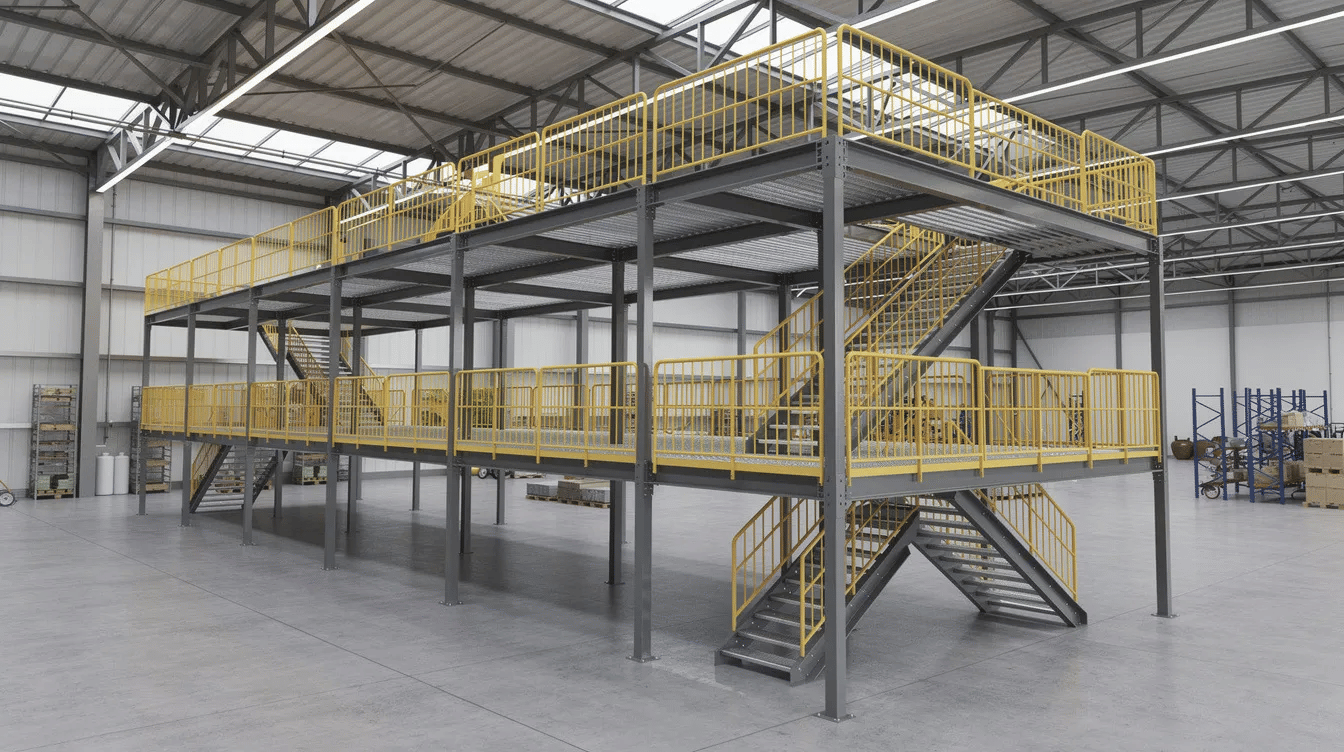
Rack-supported mezzanines and multi-level pick modules add usable square footage inside an existing building footprint without pouring new foundation. In high-clear-height buildings common along the Turnpike corridor (25 to 36 feet), a second or third level of pick faces or work platforms can double or triple available operating area within the same lease.
Integrity designs pallet rack-supported mezzanines, pallet rack catwalk systems, and pick modules around carton flow, pallet flow, selective racking, stair towers, and conveyors. These systems serve order picking, e-commerce fulfillment, and archive storage operations. Load capacity for mezzanine decks varies with intended use; walking traffic typically requires at least 60 PSF live load, while platforms supporting conveyors, equipment, or stacked cartons may need 125 to 300 PSF or more, depending on the application.
Deck type, guardrails, fall protection, egress paths, and fire sprinkler clearances must be engineered based on intended use and applicable codes. Integrity coordinates with structural engineers and local authorities as needed. The company has experience developing multi-level archive storage, records storage, and high-density carton systems for facilities in New Jersey and other markets, integrating fire protection and lighting considerations into the design.
Considering a rack-supported mezzanine or pick module? Call (201) 848-0054 to discuss vertical expansion options for your facility.
Integrating Pallet Racking With Material Handling Equipment
Pallet racking cannot be designed in isolation. Aisle widths, beam heights, and rack depths all tie back to the equipment fleet and picking strategies the facility uses. Integrity evaluates forklift types (reach trucks, turret trucks, counterbalance forklifts, pallet jacks), conveyor requirements, dock equipment, and carton flow or pallet flow lanes as part of the racking design process.
A few examples of how these interact in NJ facilities:
- Narrow-aisle selective racking paired with reach trucks in Edison or Monroe Township, where floor space is limited but clear height is generous.
- Pallet flow lanes feeding pick faces in a Cranbury e-commerce facility, where high throughput and fast delivery of orders require FIFO rotation.
- Cantilever racking designed around side-loader equipment for pipe and lumber operations in industrial zones along the Turnpike.
Integrity also recommends guard railing, rack protection accessories, wire decking, and fall protection as part of an integrated material handling package. Column protectors extend the life of pallet racking systems by absorbing forklift impacts that would otherwise damage uprights. Wire mesh decking prevents pallets from falling through beam levels and provides a stable surface for non-standard loads.
New vs. Used Pallet Racking and Cost-Effective Project Strategies
Many New Jersey warehouse operators balance project budgets against long-term performance and safety. The choice between new and used pallet racking is often central to that calculation.
New pallet racking costs range from $56.01 to $197.21 per pallet position, depending on type, capacity, and finish. Used pallet racking systems are available for $12.00 to $80.00 per position. The price gap is real, but it narrows once you account for transportation, inspection, compatibility verification, and the cost of replacing damaged or non-standard components.
When new rack makes sense: custom heights, specific load capacity requirements, special coatings (galvanized, powder coated), or branding requirements. New rack also comes with documented specifications and manufacturer warranty coverage.
When used rack can work in a cost effective manner: standard configurations, moderate loads, and projects where the timeline allows for sourcing and inspection. Integrity sources quality used pallet rack, confirms component compatibility, and verifies condition and specifications before incorporating used equipment into a design.
Integrity can also purchase surplus pallet racking from facilities undergoing consolidation or relocation, helping offset project costs where appropriate.
Request a customized budget and layout based on your specific inventory and building.
Professional Installation, Fast Delivery, and Project Phasing
Correct installation is essential for system performance, safety, and code compliance. Pallet racking installation can take from one day to a week depending on the number of bays, height, and system complexity. Experienced installation ensures racks are anchored and leveled to manufacturer tolerances and code requirements.
Integrity coordinates deliveries and staging to support fast delivery of pallet racking and material handling equipment when inventory and project conditions allow, minimizing disruption to active warehouse operations. Typical installation practices include:
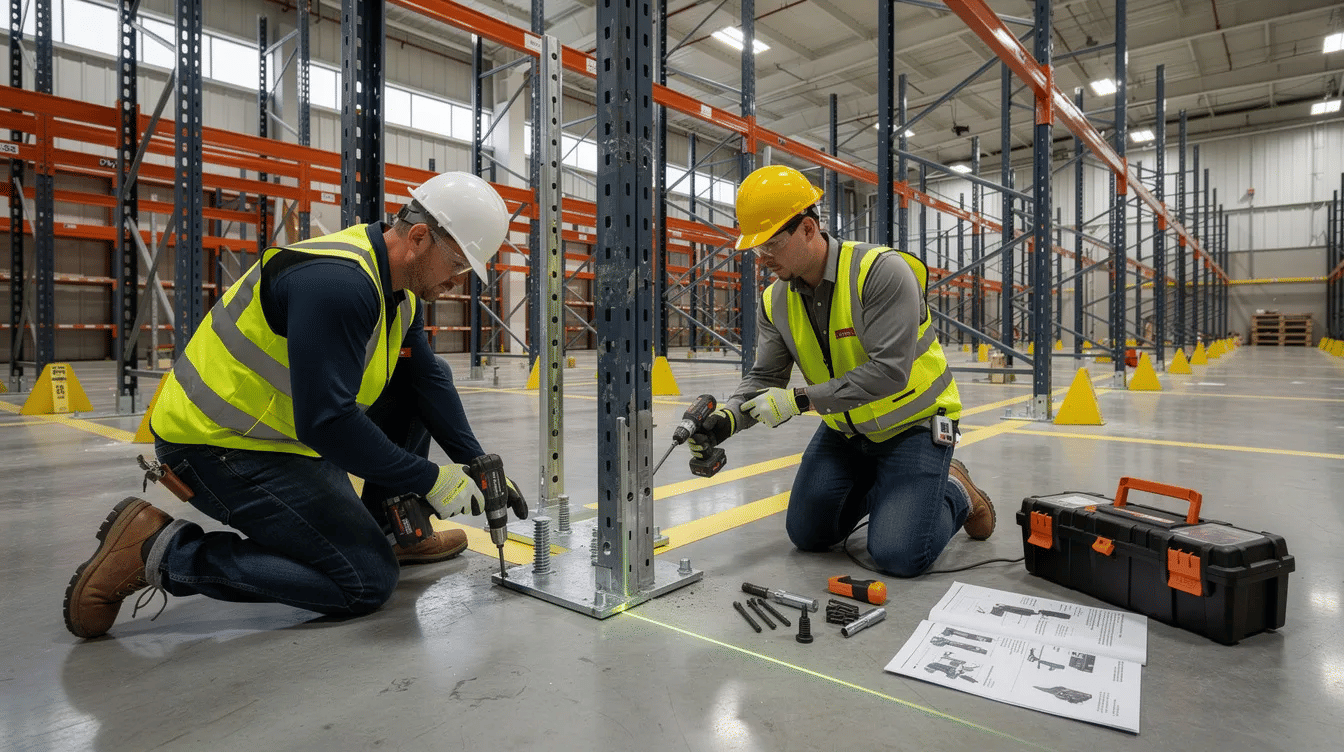
- Anchor bolt installation and verification (pallet racks must be bolted to the floor for safety)
- Plumbing and leveling uprights
- Beam and brace installation with safety clip verification
- Installation of safety accessories (column guards, end-of-row protectors, wire decking, capacity labels)
- Capacity tagging per project plans and applicable standards
Integrity can phase work around a live warehouse; nights, weekends, or staged sections keep receiving, picking, and shipping running during a rack installation or reconfiguration. For operations that measure downtime in lost business days, phased installation is often the deciding factor in provider selection.
Reconfiguring, Expanding, or Relocating Pallet Rack Systems
Many New Jersey facilities periodically reconfigure or relocate pallet racking as inventory profiles shift, customers change, or business models evolve. A 3PL that signed a contract for bulk pallet storage may need to convert drive-in lanes to selective bays a year later when a new customer brings a higher SKU count.
Best practices from Integrity's relocation and reconfiguration experience:
- Detailed field measurements and engineered layouts before any beam elevation changes
- Careful disassembly with labeling and sorting of components
- Inspection for damage: bent uprights, sheared safety pins, corroded footplates, compromised welds
- Use of compatible components during reassembly (mixing incompatible brands creates structural risk)
- Coordinated freight, staging, and re-installation at the new or renovated building
Integrity offers disassembly, relocation, and rack system reconfiguration services in New Jersey, Texas, and other states. Any reconfiguration should account for slab capacity, seismic requirements, and sprinkler and egress implications. Integrity supports customers with permit application support and updated engineering where needed, and can also purchase surplus pallet racking from facilities undergoing consolidation or relocation while handling the heavy lifting of removal and equipment management to help offset project costs where appropriate.
Rack Safety, Inspections, and Ongoing Maintenance
Heavy forklift traffic, tight aisles, and high volumes in East Coast warehouses lead to pallet rack impacts and wear over time. A single bent upright can reduce column capacity; a missing beam safety pin can allow a loaded beam to dislodge during a seismic event or forklift strike.
Integrity's rack safety assessment services include:
- Visual inspections for damaged uprights, beams, footplates, and anchors
- Checks for missing safety pins, compromised bracing, or altered beam elevations
- Assessment of whether damage falls within acceptable limits or requires repair/replacement
- Documentation of findings and recommendations
Regular inspections of racking systems are mandated to ensure structural integrity and safety compliance. A clear inspection and maintenance program for racks should be established and documented, with periodic reviews scheduled rather than triggered only by visible incidents. Integrity can recommend and provide rack protection (column guards, end-of-row protectors, guard railing, wire mesh decking) and coordinate repairs or replacement of damaged components using engineered solutions. Industry providers like RackUSA also offer installation and ongoing maintenance services, and the broader availability of these services reflects how standard regular rack maintenance has become across the industry.
Facility managers responsible for safety and compliance should schedule periodic rack safety assessments. Contact Integrity if you are unsure whether existing damage is within acceptable limits.
Industries and New Jersey Markets Integrity Serves
While Integrity manages projects nationwide, the company has extensive experience in key New Jersey warehouse, logistics, and manufacturing corridors. Representative markets and facility types include:
- Distribution centers in Edison and Raritan Center
- 3PL and e-commerce fulfillment centers in Cranbury, Monroe Township, and South Brunswick
- Port-related warehouses in Newark and Elizabeth
- Manufacturing and packaging operations in Carteret and Perth Amboy
- Records and archive storage providers across Middlesex County and Northern New Jersey
Integrity also designs and installs pallet racking and mezzanine systems in Texas and other major distribution regions, coordinating projects for both single-site and multi-facility networks. Regardless of location, projects follow the same engineered, step-by-step process from initial design through installation and follow-up support.
How to Get Started With Integrity on a New Jersey Pallet Rack Project
You do not need final answers before reaching out. Integrity's role is to help define storage requirements and develop a practical plan. Information that helps shape an initial discussion:
- Building location and approximate square footage
- Clear height (floor to lowest obstruction)
- Current and projected pallet counts
- Pallet sizes and weights (standard GMA 48x40 or other pallet dimensions)
- SKU mix and turnover rate
- Preferred or existing material handling equipment
- Timeline and any phasing constraints
Integrity typically follows up with a consultation, review of existing drawings if available, and a proposed layout and budget range before moving into detailed engineering. The goal is to identify the right racking design, not to sell steel before the facility's needs are understood.
Call (201) 848-0054 or send a message through Integrity's contact form to start planning a New Jersey pallet racking or rack-supported mezzanine project.
FAQs: Warehouse Pallet Rack Design & Installation in New Jersey
How long does a typical pallet rack installation take in a New Jersey warehouse?
Installation typically takes one day to a week for selective pallet racking projects, depending on the number of bays, height, and system complexity. Large multi-aisle or multi-level pick module installations can extend over several weeks, especially when permit reviews, fire marshal coordination, or phased work around active operations are involved. Integrity provides an estimated schedule after reviewing the layout, scope, and site conditions, and can phase work across nights, weekends, or staged sections to reduce impact on daily warehouse operations.
Can Integrity help with permits and engineering for pallet racking in my municipality?
Integrity regularly supports customers with seismic calculations, PE-stamped engineered drawings, and permit application documentation. Requirements differ between jurisdictions; Edison, Cranbury, and Newark each have their own review processes and timelines. Under New Jersey's building codes, racks 8 feet or taller require local municipal permits. Final approvals are determined by local building and fire officials, but Integrity works with licensed professionals and local authorities to develop submittal packages aligned with applicable codes. NJ code requires permit application reviews to be completed within 20 business days once submissions are complete.
Is it possible to reuse my existing pallet racking when I move to a new building?
In many cases, existing pallet racking can be evaluated for reuse, but suitability depends on component condition, specifications, and compatibility with the new building's layout, slab capacity, and clear height. Integrity inspects used rack for damage (bent uprights, sheared pins, corroded footplates), confirms component ratings where information is available, and designs new layouts that either incorporate the existing rack or blend it with additional compatible equipment. Components that fail inspection must be replaced before reassembly.
What information do I need before Integrity can design my pallet rack layout?
Helpful details include product and pallet dimensions, average and maximum pallet weights, desired pallet positions, SKU count and turnover, current and planned material handling equipment, building drawings, clear height, and known slab or column grid information. If you do not have all of this data available, Integrity's team can help gather the necessary information during an initial walkthrough or free consultation.
Does Integrity only work in New Jersey and Texas?
Integrity has operations in New Jersey and Texas and focuses on those markets for pallet racking and mezzanine projects, but the company manages warehouse storage and material handling projects across the United States. Companies outside these states should still contact Integrity to discuss their facility. The team often supports multi-site and national implementations where consistent design standards and project management are needed across locations.