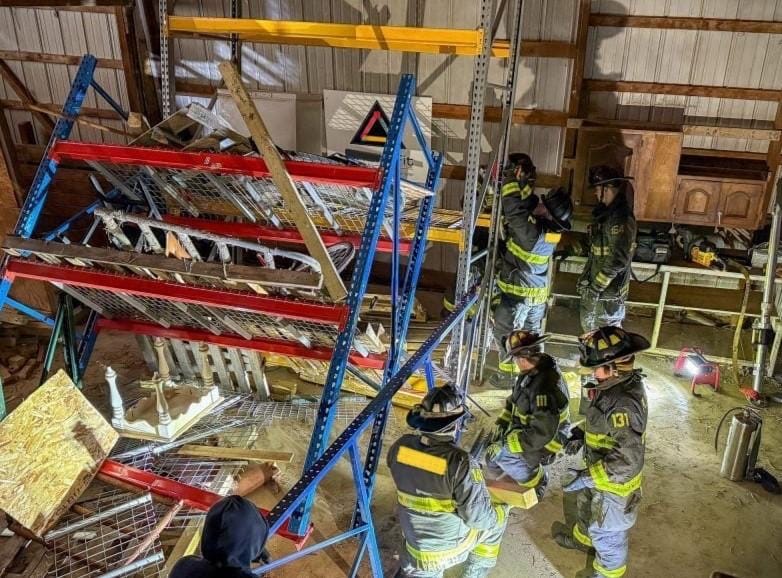
Are you prepared to correctly and lawfully respond to a warehouse incident should one occur? According to on-line data, some warehouse operations do not have any form of response protocol or do not have an adequate action plan in place to manage the wide-ranging incident possibilities.
- U.S. warehouses have high injury rates — 4.8 recordable cases per 100 full-time workers in 2025.
- Transportation & warehousing has one of the highest OSHA recordable incident rates at 4.5 per 100 workers.
- Safety benchmarking guidance emphasizes emergency-response readiness (evacuation plans, spill response, crisis management), implying that having a plan is considered a best-practice policy, but is not universally adopted.
Concise takeaway
A realistic, evidence-based estimate is that the percentage of U.S. warehouses having a formal incident-protocol or emergency-response plan in place is 65–80%.
📊 Step-by-step estimate model
1. OSHA Regulatory Baseline
OSHA requires Emergency Action Plans (EAPs) only for facilities with specific hazards (e.g., fire, chemical exposure, evacuation needs). Warehouses often fall under these categories, but not universally.
- Roughly 60% of warehouses are subject to OSHA standards that implicitly require an EAP.
- OSHA does not verify or track whether the plan actually exists.
Compliance assumption: 60–70% of regulated warehouses maintain a plan. Don’t be the missing 30-40%!
2. Insurance-Driven Requirements
Commercial property and workers’ compensation insurers frequently require:
- Incident-response protocols
- Hazard communication plans
- Evacuation procedures
- Spill response plans
Insurance compliance is highest among medium and large warehouses.
- Large warehouses (100+ employees): ~90% compliance
- Mid-size warehouses (20–99 employees): ~75% compliance
- Small warehouses (<20 employees): ~40–50% compliance
Weighted by industry size distribution, this yields ≈70% compliance.
3. Third-Party Safety Audits
Major logistics operators (3PLs, e-commerce fulfillment, retail distribution centers) use:
- ISO 45001
- ANSI Z10
- Internal corporate safety audits
These groups represent ~35–40% of U.S. warehouse square footage and have 90–95% adoption of incident protocols.
This pushes the overall industry average upward.
4. Small Warehouse Drag Factor
The U.S. warehouse landscape is fragmented:
- ~55% of warehouses have fewer than 20 employees
- Small operators often lack formal documentation
- Many rely on informal procedures rather than written plans
This group significantly reduces the national average.
Estimated adoption among small warehouses: 40–55%.
📐 Putting it all together (weighted model)
| Warehouse size | Share of facilities | Estimated adoption | Weighted contribution |
|---|---|---|---|
| Small (<20 employees) | 55% | 40–55% | 22–30% |
| Mid-size (20–99 employees) | 30% | 70–80% | 21–24% |
| Large (100+ employees) | 15% | 90–95% | 13–14% |
Estimated total adoption: 65–80%
This range is consistent with:
- OSHA compliance patterns
- Insurance requirements
- Corporate safety audit prevalence
- Industry fragmentation
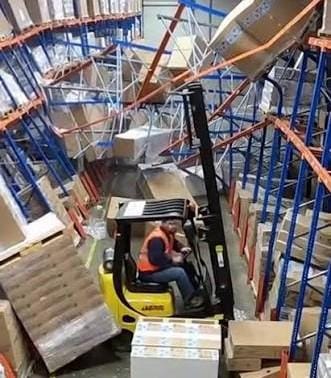
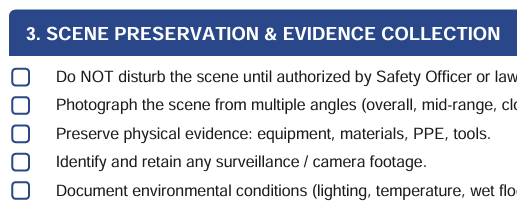
Have a solid, well documented and rehearsed action plan in place to respond to and manage any possible scenario you may encounter in your workplace. A thorough checklist with delegated responsibilities is the best way to stay on top of an incident before wrong, yet unintentional steps are taken that could jeopardize or hinder the follow up inspection.
Of course, taking the proactive approach to proper training, preparedness and monthly safety meetings go a long way in preventing accidents in the first place.
See our Insight on "Warehouse Safety Training Program and Checklist" here.
The Integrity Team can guide you through the proper training process as well as a response protocol that best suits your operation. Give us a call today.